For window products placed on the European market, CE marking is a legal requirement under the EU Construction Products Regulation (CPR). To obtain CE marking, a manufacturer must demonstrate compliance with a harmonized technical standard for windows and pedestrian doors.
A CE certificate issued by an EU notified body confirms that a window system has been tested and meets the required performance criteria.
What a CE Certificate Typically Includes
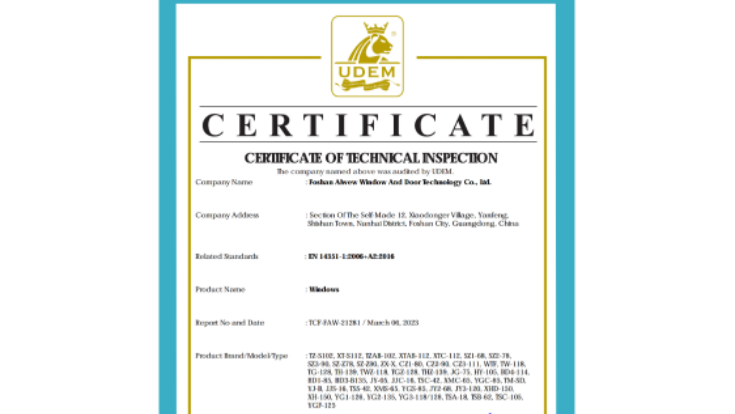
A valid CE certificate from a recognized notified body lists the following:
The manufacturer’s name and facility address
The applicable harmonized standard
A unique report number for traceability
The product family or series covered
Unlike certificates that cover only one or two sample units, some certificates apply to a broad range of models. A certificate that lists hundreds of distinct product codes indicates that the manufacturer’s quality control system extends across the entire product line, not just a few showcase items.
For buyers, this reduces the risk that a certified sample will perform differently from the actual delivered product.
What the Standard Tests
The harmonized standard for windows defines minimum performance levels and standardized test methods for key characteristics:
Water tightness
Air permeability
Wind load resistance
Thermal transmittance (U‑value)
Operating force
Mechanical strength
Each characteristic is assigned a performance class. The certificate states the achieved class, allowing specifiers to select products appropriate for their specific building location and exposure conditions.
Water tightness
Air permeability
Wind load resistance
Thermal transmittance (U‑value)
Operating force
Mechanical strength
Why This Matters for Project Delivery
For projects located in EU member states, local building inspectors and customs authorities accept CE certification as proof of conformity. Without valid documentation, shipments may be delayed, rejected on site, or require costly retesting.
CE certification also enables fair comparison between suppliers. Because all manufacturers use the same test methods, performance data can be compared directly across different brands. This transparency supports value engineering and reduces negotiation friction.
If a performance dispute arises, the certificate and its associated test report provide a documented benchmark. The specifier or contractor can refer to the report to verify claimed performance, shifting the discussion from opinion to evidence.

From Certificate to Actual Product
A certificate alone does not guarantee that every single window leaving the factory will perform identically to the tested sample. However, when a certificate covers a wide range of models and the manufacturer maintains documented process controls, the probability of deviation is significantly lower.
Manufacturers who invest in third‑party certification also tend to invest in consistent extrusion, surface treatment, and assembly processes. The certificate is not an endpoint but an indicator of overall production discipline.
For the project team, specifying certified products means less time chasing documentation, fewer surprises during handover, and a clearer path to resolving genuine performance issues.
Additional System Capabilities
Manufacturers of CE‑certified windows often also offer electric opening systems – controlled by voice, mobile app, remote, or wall switch – as well as sliding interior doors (PD doors) that keep entryways clear. These additions do not replace the core mechanical certification; they build upon it. The underlying window structure remains fully compliant, ensuring that even motorized or smart variants meet European weather performance standards.
Conclusion
CE certification is not a decorative badge. It is a tool for risk management in European and internationally aligned projects. A certificate issued by an independent notified body – especially one that covers a broad product range – provides specifiers with confidence that the product line has been systematically evaluated.
When reviewing a supplier’s documentation, look beyond the logo. Check the scope of models, the report number, and the standard version. A manufacturer that can produce a certificate with broad coverage and consistent process alignment demonstrates a clear understanding of the difference between marketing and engineering.