
If you are importing electronic products or smart building components into the European Union, you have likely encountered the term RoHS. It stands for Restriction of Hazardous Substances, and compliance is not optional – it is a legal requirement under EU Directive 2015/863.
What RoHS Restricts
RoHS limits the use of ten hazardous substances in electrical and electronic equipment. These include lead, mercury, cadmium, hexavalent chromium, and certain flame retardants. Products that exceed the maximum allowed concentrations cannot be sold in the EU.
For smart windows and doors – which contain motors, sensors, control boards, and wireless modules – RoHS compliance is essential. Without it, your shipment may be refused at the border, destroyed, or subject to heavy fines.
What Our RoHS Certificate Shows
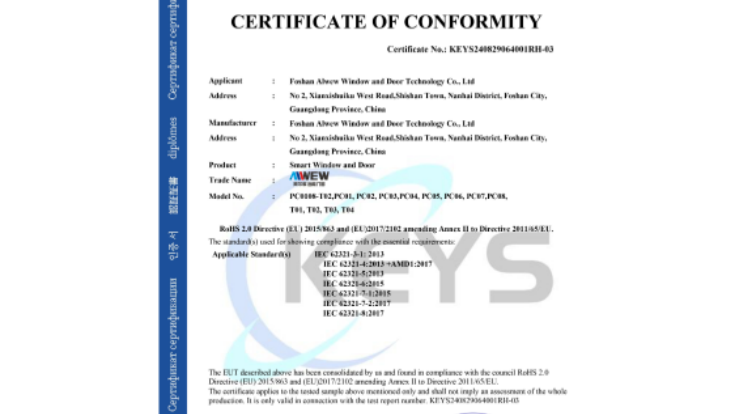
Our products have been tested by an accredited third‑party laboratory. The certificate confirms that our smart window and door systems – covering multiple models – comply with RoHS 2.0 Directive (EU) 2015/863 and its amending directive (EU) 2017/2102.
The tests were performed using international standards (IEC 62321 series), which are recognised worldwide. A unique certificate number and test report number allow full traceability. The certificate applies to the tested samples, and our production processes are maintained to ensure ongoing compliance.
Why RoHS Matters for Your Project
1. Customs clearance – EU customs authorities require RoHS documentation for any electronic product. Presenting a valid certificate speeds up entry and avoids costly inspections.
2. Legal compliance – Selling non‑RoHS products in the EU can result in penalties, product recalls, or bans. A certificate protects you as the importer or specifier.
3. Health and safety – RoHS ensures that no toxic substances leach from the product into your home or environment. This is especially important for indoor applications like smart windows, which are operated daily.
4. Professional credibility – Suppliers who invest in RoHS testing demonstrate that they take quality and environmental responsibility seriously.
Which Products Are Covered
The certificate applies to our smart window and door systems, including multiple model series. These include electric casement windows, sliding doors, and other motorized opening systems. The wide model coverage means that RoHS compliance is not limited to a single “golden sample” – it applies across our ALWEW product line.
Beyond RoHS: A Commitment to Quality
RoHS is just one part of our overall quality assurance. Our smart windows also carry CE marking, EN 14351‑1 certification for mechanical performance, and other regional approvals. We believe that a responsible manufacturer should be transparent about materials, testing, and supply chain control.
When you specify ALWEW smart windows and doors for your project, you are choosing products that are safe for both people and the planet – and fully compliant with EU environmental regulations.